
Build products that keep getting better
Factory is being built to turn customer problems into lasting improvements across your products. Set the direction and the limits. Factory should carry the work through independent checks, release and measurement, and ask for your help when it needs a decision only you can make.
In development Local foundations are independently reviewed; the complete delivery process is still being built.
One change, followed through
Illustrative example
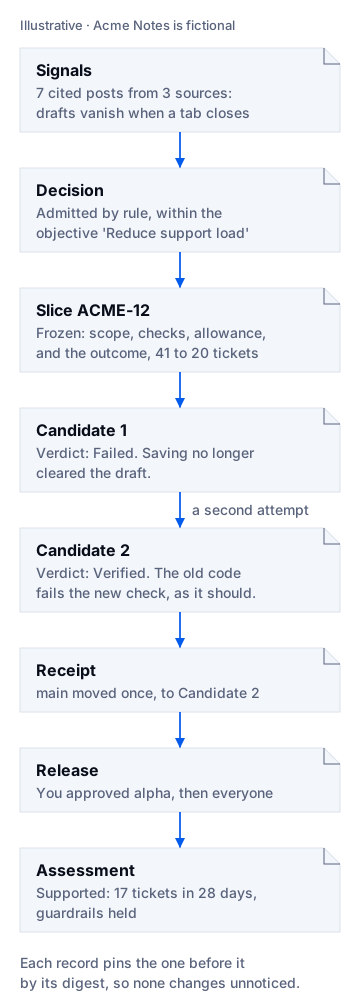
One Slice for Acme Notes, record by record
Acme Notes users say their drafts vanish when a browser tab closes. Factory freezes one Slice to fix it: the smallest change, the checks it must pass and the drop in support tickets it should bring.
The first Candidate fails its checks, because saving no longer clears the draft; the second is Verified, and the branch moves once.
After release, 'lost draft' tickets fall from 41 to 17 in 28 days with the guardrails held, so the Assessment says Supported. Had they not, it would say Rejected, and the Slice would close as learning, not as a win.
A customer problem should end in a better product
The ambition is sustained product improvement. Understand the need, build a focused change, check it independently, release it safely and measure whether it helped. Explore the stages and their current status below.

Explore the nine stages and their current status
-
1. Discover
In development
Read each product's public sources and sort what customers say into Signals.
Leaves cited Signals: what customers said, each kept with its exact quote and source.
-
2. Decide
Planned
Turn the strongest Signals into a few proposals, and let rules decide first.
Leaves a decision: admitted, parked or rejected, naming the rule behind it.
-
3. Slice
In development
Freeze the smallest useful change, its checks and how its outcome will be measured.
Leaves a frozen Slice: the smallest useful change, fixed with its checks before any code is written.
-
4. Build
In development
A model proposes bounded edits; Repository seals them as an exact Candidate.
Leaves a Candidate: the proposed edits, sealed so that any later change to them is detected.
-
5. Verify
In development
Run the frozen checks in a sandbox and judge the Evidence, never the builder's word.
Leaves a Verdict: Verified, Failed or Inconclusive, judged from Evidence alone.
-
6. Integrate
In development
Re-derive the Verdict, then move the branch once, and never retry blindly.
Leaves a Receipt: confirmation that the branch moved, exactly once.
-
7. Release
Planned
Draft the release from checked facts; nothing goes out without your approval.
Leaves a release record: your approval of the exact draft, and the channel's confirmation.
-
8. Measure
Planned
Compare what happened with the promised outcome: Supported, Rejected or Inconclusive.
Leaves an Assessment: whether it helped, concluded as Supported, Rejected or Inconclusive.
-
9. Keep, renew or retire
Planned
Keep what serves customers, renew it on evidence of friction, retire it on purpose.
Leaves Capabilities: abilities with an owner and checks, kept, renewed or retired on evidence.
Progress you can inspect
Factory is being built around independent checks and visible evidence. These foundations already work within the local scopes shown here. Read the trust model.
-
The builder never checks its own work
Working today · verified
The builder cannot accept its own work. Independent review checks the local implementation, and the acceptance record retains the evidence and any failed rounds.
Scope: Verdicts on the built-in fixtures today, and the review of every accepted module.
Evidence: Evidence and Assurance guide · Build review
-
Unknown is never zero
Working today · verified
A number Factory cannot vouch for shows a dash and the reason, never a false 0, and a check that times out or loses a record is Inconclusive, never a pass.
Scope: The local dashboard, Portfolio counts, fixture Verdicts and the command journal today.
Evidence: Portfolio guide · Command journal guide · Dashboard receipt (JSON)
-
Bounded, and products kept apart
Working today · verified
Each run's limits on tries and time are fixed when it starts and never extended, oversized input is refused rather than truncated, and each product is kept to a checkout of its own.
Scope: The local fixtures, records and registry today.
Evidence: Execution guide · Project guidance guide
See the first working foundation
The local dashboard brings product progress, open actions and recorded usage into one view. It shows what its sources establish and makes gaps visible. Current capabilities and evidence.
The owner's real Portfolio, approved for publication on 29 September 2026
The local dashboard, as accepted
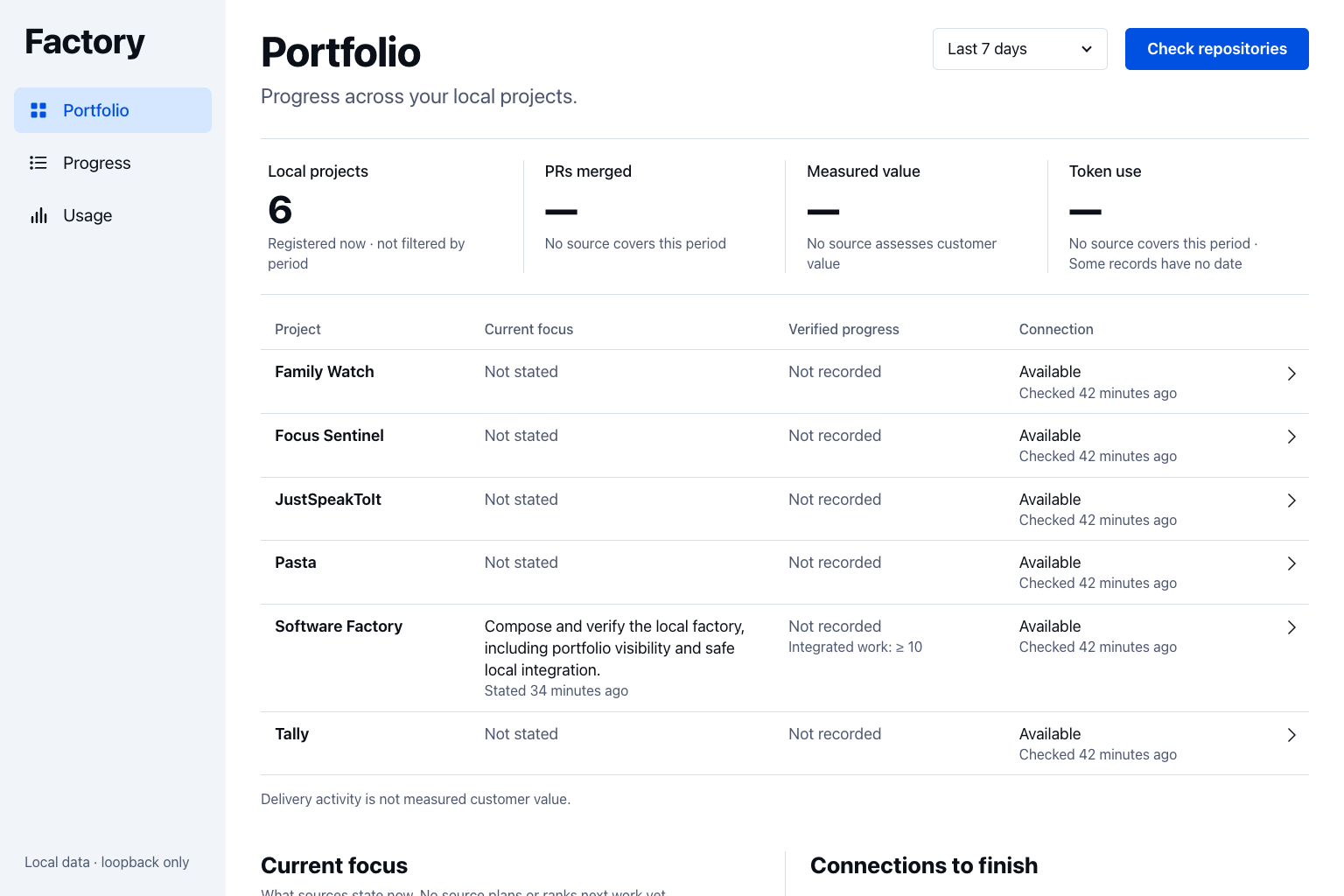
The Portfolio view on 28 September 2026, byte for byte the capture its acceptance receipt (JSON) records: a picture of that day, not a live view. Measured value and token use show a dash and the reason, never 0. It names the owner's real products, and the owner approved it for publication on 29 September 2026.
Meet Plumb
Factory has a character: Plumb, a small blue plumb bob. The line stands for the bounds you delegate; the weight stands for evidence. Plumb swings to explore and settles true: every claim hangs from evidence.

Explore the parts
Follow progress
The Status page lists each accepted step with its evidence, newest first, and the docs explain every part in depth, limits included.